Real Estate Leads Pricing: What Agents Should Expect to Pay
10 mins read
Published Apr 2, 2025

How Real Estate Lead Pricing Works
Real estate lead pricing is determined primarily by how the platform generates consumer inquiries.
Most lead generation companies rely on digital marketing channels such as search engines, social media advertising, and real estate portals to attract potential buyers and sellers. These marketing campaigns create traffic, and when consumers submit their contact information requesting assistance, those inquiries become leads.
The cost of generating that traffic influences the price of the lead. Advertising competition, geographic demand, and targeting criteria all affect how expensive it is to generate a real estate inquiry.
Because these variables differ between markets, the price of leads can vary significantly depending on location and platform.
Average Cost of Real Estate Leads
Across the industry, real estate leads typically range from $20 to $80 per inquiry depending on the platform and the competitiveness of the market.
Buyer leads generated through search advertising or home search portals often fall within this range. In highly competitive metropolitan markets, the effective cost per lead can increase even further.
Some platforms deliver a large volume of inquiries at lower prices but share those leads among multiple agents. Others attempt to deliver exclusive leads to a single agent at a higher cost.
Understanding how many agents receive each lead is just as important as understanding the price.
Pay-Per-Lead Pricing Models
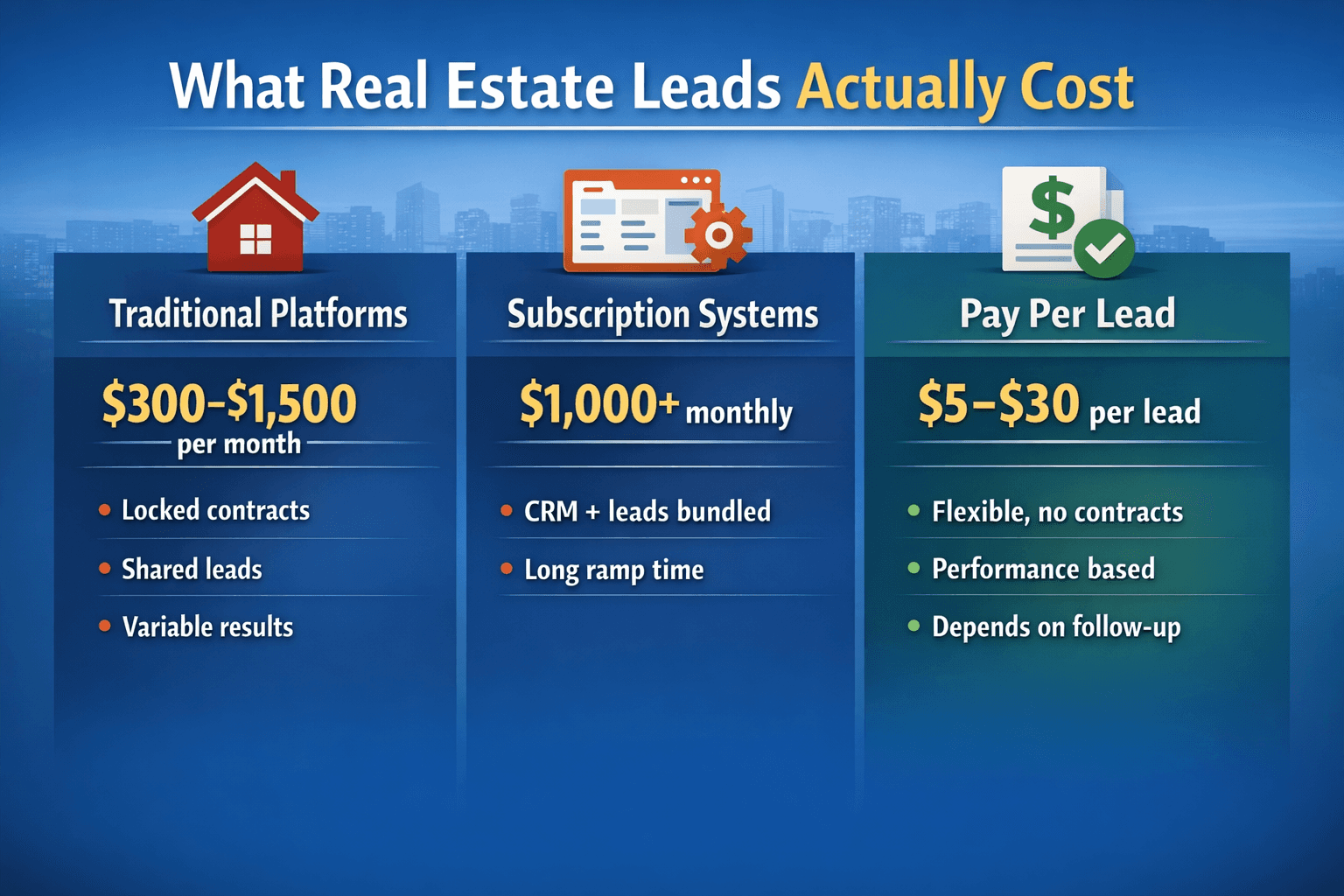
Pay-per-lead platforms sell individual inquiries or bundles of leads directly to agents.
Instead of committing to a recurring monthly subscription, agents purchase leads when they want them. This approach allows agents to test a lead source without locking into long-term agreements.
Pay-per-lead models can offer greater flexibility because agents control when they purchase new inquiries.
Some platforms allow agents to purchase bundles of buyer inquiries directly from their platform homepage:
Agents interested in how those inquiries are routed and distributed can review the process here:
Subscription Lead Pricing
Many lead generation companies operate on subscription or advertising models rather than selling individual leads.
In subscription systems, agents commit to a monthly budget in exchange for ongoing exposure to potential buyers and sellers. Leads generated through that advertising are delivered continuously while the subscription remains active.
This model can produce steady lead flow, but it can also make pricing harder to predict because agents pay for exposure rather than individual inquiries.
Agents researching subscription systems often compare them with pay-per-lead alternatives to determine which pricing structure offers better flexibility.
Advertising-Based Lead Pricing
Some lead platforms use advertising share rather than fixed lead pricing.
In these systems, agents purchase visibility within a specific geographic market. The more advertising share an agent controls, the more frequently they appear to buyers browsing properties.
Because these systems focus on exposure rather than individual leads, the number of inquiries delivered can fluctuate depending on consumer activity.
For example, platforms such as Zillow use advertising share to determine which agents receive buyer inquiries connected to listings. Agents researching that system often compare it with other pricing models, which is discussed in detail in the article:
Exclusive vs Shared Lead Pricing
Another factor that affects lead pricing is whether the inquiry is exclusive or shared.
Shared leads are distributed to multiple agents simultaneously. Because several agents may attempt to contact the same buyer, shared leads usually cost less.
Exclusive leads are delivered to only one agent. These leads reduce competition but generally cost more because the platform cannot sell the same inquiry to multiple agents.
Agents evaluating lead pricing should always determine whether the leads are exclusive or shared before purchasing.


What Determines Lead Value
The true value of a real estate lead depends on more than the price of the inquiry.
Lead source quality plays a major role. Leads generated from consumers actively requesting an agent often convert better than passive inquiries generated from advertising.
Response speed also influences conversion rates. Studies across the real estate industry show that agents who respond within a few minutes have a significantly higher chance of connecting with buyers.
Follow-up consistency is another important factor. Many buyers begin their home search months before they purchase, which means long-term follow-up often determines whether a lead converts into a transaction.
Comparing Real Estate Lead Platforms
Because pricing models vary widely, agents often compare multiple lead generation companies before choosing a platform.
Some agents prefer subscription models that provide continuous lead flow. Others prefer pay-per-lead systems that allow them to control how many inquiries they purchase.
Platforms that allow agents to purchase leads directly can offer flexibility when testing new lead sources. Examples of delivered inquiries and testimonials from agents can be reviewed here:
https://delivery.realleadsco.com
Comparing lead sources carefully allows agents to evaluate both pricing and lead quality before investing significant marketing budget.

Frequently Asked Questions About Real Estate Lead Pricing
How much do real estate leads usually cost?
Real estate leads typically range between $20 and $80 per inquiry depending on the platform and the competitiveness of the market.
Are more expensive leads better quality?
Not necessarily. Lead quality depends on the source of the inquiry and how the consumer entered the system. Some lower-cost leads can perform well when agents respond quickly and maintain consistent follow-up.
What is the cheapest way to buy real estate leads?
Pay-per-lead platforms often allow agents to test smaller lead purchases without committing to recurring subscriptions, which can provide more flexibility when evaluating new lead sources.
How should agents compare lead platforms?
Agents should compare pricing structure, lead distribution method, response competition, and the source of the inquiry before choosing a lead generation platform.
“Framer is one of the best web builders I have ever tried. It’s like magic.”
Author
Key Takeaways
Real estate lead pricing varies widely depending on how the platform generates inquiries and distributes those leads to agents.
Some systems operate through advertising exposure, while others sell individual inquiries directly. Shared leads tend to cost less but involve competition, while exclusive leads may cost more but provide a clearer opportunity to connect with the buyer.
Understanding these differences allows agents to evaluate lead platforms more effectively and determine which pricing structure fits their marketing strategy.

Swipe. Buy. Close.
Scale your pipeline faster. Consistent lead volume delivered to your inbox. Simple process.
Secure checkout. No friction. Your purchase is processed securely through Stripe with encrypted payment handling.
Ready to close deals? Fuel your funnel with live inquiries and pricing built to scale.
Real Estate Leads Pricing: What Agents Should Expect to Pay
10 mins read
Published Apr 2, 2025
How Real Estate Lead Pricing Works
Real estate lead pricing is determined primarily by how the platform generates consumer inquiries.
Most lead generation companies rely on digital marketing channels such as search engines, social media advertising, and real estate portals to attract potential buyers and sellers. These marketing campaigns create traffic, and when consumers submit their contact information requesting assistance, those inquiries become leads.
The cost of generating that traffic influences the price of the lead. Advertising competition, geographic demand, and targeting criteria all affect how expensive it is to generate a real estate inquiry.
Because these variables differ between markets, the price of leads can vary significantly depending on location and platform.
Average Cost of Real Estate Leads
Across the industry, real estate leads typically range from $20 to $80 per inquiry depending on the platform and the competitiveness of the market.
Buyer leads generated through search advertising or home search portals often fall within this range. In highly competitive metropolitan markets, the effective cost per lead can increase even further.
Some platforms deliver a large volume of inquiries at lower prices but share those leads among multiple agents. Others attempt to deliver exclusive leads to a single agent at a higher cost.
Understanding how many agents receive each lead is just as important as understanding the price.
Pay-Per-Lead Pricing Models
Pay-per-lead platforms sell individual inquiries or bundles of leads directly to agents.
Instead of committing to a recurring monthly subscription, agents purchase leads when they want them. This approach allows agents to test a lead source without locking into long-term agreements.
Pay-per-lead models can offer greater flexibility because agents control when they purchase new inquiries.
Some platforms allow agents to purchase bundles of buyer inquiries directly from their platform homepage:
Agents interested in how those inquiries are routed and distributed can review the process here:
Subscription Lead Pricing
Many lead generation companies operate on subscription or advertising models rather than selling individual leads.
In subscription systems, agents commit to a monthly budget in exchange for ongoing exposure to potential buyers and sellers. Leads generated through that advertising are delivered continuously while the subscription remains active.
This model can produce steady lead flow, but it can also make pricing harder to predict because agents pay for exposure rather than individual inquiries.
Agents researching subscription systems often compare them with pay-per-lead alternatives to determine which pricing structure offers better flexibility.
Advertising-Based Lead Pricing
Some lead platforms use advertising share rather than fixed lead pricing.
In these systems, agents purchase visibility within a specific geographic market. The more advertising share an agent controls, the more frequently they appear to buyers browsing properties.
Because these systems focus on exposure rather than individual leads, the number of inquiries delivered can fluctuate depending on consumer activity.
For example, platforms such as Zillow use advertising share to determine which agents receive buyer inquiries connected to listings. Agents researching that system often compare it with other pricing models, which is discussed in detail in the article:
Exclusive vs Shared Lead Pricing
Another factor that affects lead pricing is whether the inquiry is exclusive or shared.
Shared leads are distributed to multiple agents simultaneously. Because several agents may attempt to contact the same buyer, shared leads usually cost less.
Exclusive leads are delivered to only one agent. These leads reduce competition but generally cost more because the platform cannot sell the same inquiry to multiple agents.
Agents evaluating lead pricing should always determine whether the leads are exclusive or shared before purchasing.
What Determines Lead Value
The true value of a real estate lead depends on more than the price of the inquiry.
Lead source quality plays a major role. Leads generated from consumers actively requesting an agent often convert better than passive inquiries generated from advertising.
Response speed also influences conversion rates. Studies across the real estate industry show that agents who respond within a few minutes have a significantly higher chance of connecting with buyers.
Follow-up consistency is another important factor. Many buyers begin their home search months before they purchase, which means long-term follow-up often determines whether a lead converts into a transaction.
Comparing Real Estate Lead Platforms
Because pricing models vary widely, agents often compare multiple lead generation companies before choosing a platform.
Some agents prefer subscription models that provide continuous lead flow. Others prefer pay-per-lead systems that allow them to control how many inquiries they purchase.
Platforms that allow agents to purchase leads directly can offer flexibility when testing new lead sources. Examples of delivered inquiries and testimonials from agents can be reviewed here:
https://delivery.realleadsco.com
Comparing lead sources carefully allows agents to evaluate both pricing and lead quality before investing significant marketing budget.
Frequently Asked Questions About Real Estate Lead Pricing
How much do real estate leads usually cost?
Real estate leads typically range between $20 and $80 per inquiry depending on the platform and the competitiveness of the market.
Are more expensive leads better quality?
Not necessarily. Lead quality depends on the source of the inquiry and how the consumer entered the system. Some lower-cost leads can perform well when agents respond quickly and maintain consistent follow-up.
What is the cheapest way to buy real estate leads?
Pay-per-lead platforms often allow agents to test smaller lead purchases without committing to recurring subscriptions, which can provide more flexibility when evaluating new lead sources.
How should agents compare lead platforms?
Agents should compare pricing structure, lead distribution method, response competition, and the source of the inquiry before choosing a lead generation platform.
“Framer is one of the best web builders I have ever tried. It’s like magic.”
“Framer is one of the best web builders I have ever tried. It’s like magic.”
Author
Key Takeaways
Real estate lead pricing varies widely depending on how the platform generates inquiries and distributes those leads to agents.
Some systems operate through advertising exposure, while others sell individual inquiries directly. Shared leads tend to cost less but involve competition, while exclusive leads may cost more but provide a clearer opportunity to connect with the buyer.
Understanding these differences allows agents to evaluate lead platforms more effectively and determine which pricing structure fits their marketing strategy.